
International Monetary Fund Managing Director Dominique Strauss-Kahn has announced his intention to appoint Anoop Singh as Director of the Asia Pacific Department. Singh, an Indian national, who is currently Director of the IMF's Western Hemisphere Department, will succeed David Burton. He holds graduate and post graduate degrees from the Universities of Bombay, Cambridge, and the London School of Economics. Singh has also been special advisor to the governor of the RBI.
The Reserve Bank of India on Friday said it will unveil the annual credit policy for 2009-10, which is expected to provide further stimulus to the economy, on April 21.
A day after the Reserve Bank kept key interest rates unchanged, the International Monetary Fund on Wednesday said further interest rate increases are needed in India with monetary conditions still accommodative and credit expanding strongly.
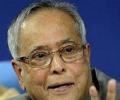
He will pitch for American investment in Indian business opportunities.
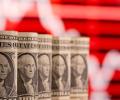
In the steepest weekly fall ever, India's forex reserves slid by $11.17 billion to $606.47 billion as the currency came under pressure due to geopolitical developments, according to the Reserve Bank data released on Friday. For the previous reporting week ended March 25, the overall reserves had slid by $2.03 billion to $617.65 billion. The steep fall in the reserves was because of a decline in the core currency assets, which fell by $10.73 billion to $539.73 billion.
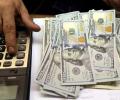
Gold reserves rose by $321 million in the reporting week to $37.521 billion.
India lags behind 132 countries in per capita income.

On global imbalances, Lagarde noted that IMF is assessing external imbalances and misalignments through its new External Sector Report.
Apart from Lagarde, Mexican central bank governor Agustin Carstens and Kazakhstan's central bank governor Grigory Marchenkois are in the fray for the IMF managing director's post which fell vacant after the ignominious exit of Dominique Strauss-Kahn last month.
Christine Lagarde recently gave a speech in which she outlined steps needed to avoid future global crisis.
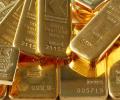
The government's initiative to migrate SEZ data from NSDL software to ICEGATE system for streamlined reporting of import data caused double counting of gold imports, resulting in inflated figures and the issue has now been largely rectified, government sources said. The downward revision has provided the actual picture of trade deficit (difference between imports and exports), which was earlier looking very high. The deficit for November will now be revised downwards from $37.84 billion to about $32.8 billion. Similarly, there will be a revision in overall import numbers as well.

'When Prime Minister Modi met President Trump, they agreed to initiate a bilateral trade dialogue.' 'It makes sense to give these negotiations a chance.'

"India did a self-assessment (by the Committee on Financial Sector Assessment, or CFSA) of its financial sector in 2009. This has given us the confidence to get our financial sector evaluated by international financial institutions like IMF and the World Bank. We have voluntarily sought a full-fledged Financial Sector Assessment Programme," Finance Minister Pranab Mukherjee said at the second International Finance Conference at the Indian Institute of Management, Calcutta.
While most European countries are backing Lagarde, the developing countries are trying to build a consensus on nominating a person from the emerging nations as the next IMF chief.
Moments before he was taken off a France-bound flight last week, Strauss-Kahn reportedly told the flight attendant, 'what a nice a**' or in French, 'Quel beau cul!', The New York Post reported.

Until now the Fund has sold 212 metric tonnes of gold but it was limited to central banks.

The IMF Board of Governors have approved a general allocation of special drawing rights equivalent to $250 billion to provide liquidity to global economic system by supplementing its member countries' foreign exchange reserves.
International Monetary Fund has warned emerging markets, which have so far weathered the ongoing financial crisis, that they may not be completely insulated, while noting that risks to India's financial sector appeared manageable. The top international organisation has raised the assessment of market risks for the emerging markets including on capital flows. It said that despite generally strong external positions, some concerns have arisen about dollar funding in Asia.

The country's foreign exchange reserves rose by $835 million to touch a record high of $612.73 billion in the week ended July 16, 2021, RBI data showed. In the previous week ended July 9, 2021, the reserves had surged by $1.883 billion to $611.895 billion. In the reporting week ended July 16, 2021, the increase in forex reserves was on account of the rise in foreign currency assets (FCA), Reserve Bank of India's (RBI) weekly data released on Friday showed.

International Monetary Fund has said more remains to be done to put the US public finances back on sustainable path.
The IMF, in its latest World Economic Outlook report, also said India is among the economies that may require more tightening to address inflation pressure.
The IMF, in its latest World Economic Outlook report, also said India is among the economies that may require more tightening to address inflation pressure.

There is evidence of asymmetric adjustment to monetary policy
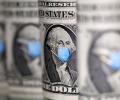
The country's foreign exchange reserves declined by a massive $6.24 billion to reach $583.945 billion in the week ended February 5, RBI data showed on Friday. In the previous week, the reserves had touched a record high of $590.185 billion after rising by $4.852 billion. In the reporting week ended February 5, the decline in the forex kitty was mainly on account of a fall in foreign currency assets (FCAs), a major component of the overall reserves.
India's economic growth is likely to shrink by 1.25 per cent to 7.9 per cent this fiscal, mainly on account of tight monetary conditions and continued pressure on inflation, the International Monetary Fund said on Friday. The IMF report also warned that investment would be more affected than consumption on account of the tight monetary conditions and fall in global economy following US sub-prime crisis. Compared to China, India has little fiscal space to keep up the growth.

The International Monetary Fund on Wednesday warned that there are significant risks of the crisis recurring, as long as global banking system remains strained.
Raghuram Rajan, a former chief economist at the International Monetary Fund, takes charge at the RBI as the country faces its worst economic crunch since a balance of payments crisis two decades ago.
Raghuram Rajan becomes the 23rd governor of Reserve Bank of India.
It will depend on how the Fund chooses to deploy its newfound power, asks Dani Rodrik.
Rediff.com spoke to Raghuram Rajan about his book, what enthuses him about the Indian economy, and what are the concerns he has with India's chaotic progress . . .
The International Monetary Fund welcomed the commitment made by the G-20 Summit on Thursday to enhance the multilateral agency's ability to support emerging markets and low-income countries, and to bring the world economy out of its deepest post-war recession.

'Whether I am optimistic or pessimistic is not the issue; I am just going by the evidence available.' 'The Indian economy and financial sector are now well-placed and very resilient in dealing with any kind of spillover coming from the external world.'
When Pandit was in Japan last week, meeting International Monetary Fund and World Bank officials, Michael E O'Neill, the new chairman of Citigroup since April, was applying the final touches of his masterplan to remove Pandit.
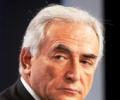
Strauss-Kahn, 62, allegedly forced the maid at the Sofitel hotel in Manhattan to perform oral sex.

German Chancellor Angela Merkel had assured the Greek leaders her continued support for the country to remain in the euro zone when she last Wednesday made her first visit to Athens in nearly three years.


The International Monetary Fund has lowered India's economic growth forecast by 1 per cent to 5-6 per cent for 2012-13.
A rapidly deteriorating balance of payments may warrant that but the political climate is too risky
